
To Build A Mystara City
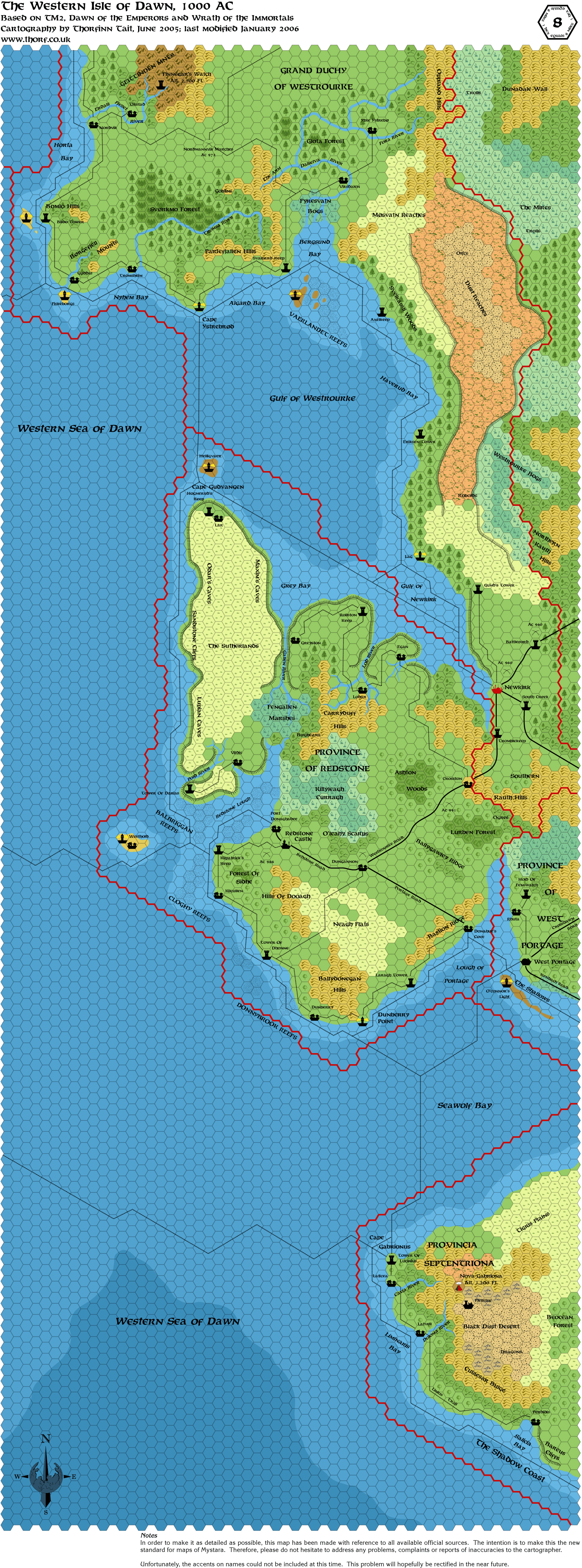
by Jesper AndersenThis map of the Isle of Dawn shows the areas where the new city is being constructed. The dominion of Lord Alexander is somewhere in between the Carryduff Hills and the Ashton Woods east of the Killyleagh Curragh marshes and swamps in the province of Redstone.
The Build A City Thread – Year 1, Month 1
[Journal]
Lord Alexander shifted uneasily in his saddle when he saw for the first time the lands that were now officially his. His mount was still panting from the recent gallop and its breath formed clouds of vapour in the chill winter air. Although winter was waning, the ground was still frozen and covered in a light blanket of snow and there was ice along the riverbank.
Behind him Lord Alexander's men were also watching the valley in front of them, as if they were trying to determine whether this was paradise - or hell. Like a prisoner who had long awaited his sentence, Lord Alexander was relieved to finally be here and see these lands with his own eyes. He had served in the Imperial Thyatian Legions for almost two decades and ended his career as a distinguished centurion and deputy second-in-command of the proud 12th Legion. As such, he should have been awarded a fief in the rich Imperial Territories on the Trevonian River. But ill fate - or rather his lack of respect for certain powerful men in the Senate - had caused him to be sent to colonise this inhospitable piece of wilderness instead.
The irony of it all was that they had used his distinguished career as a soldier through 20 years as an excuse to send him here. 'Men of his character and strength' they had said, 'were needed to conquer the frontier and secure more farmland and resources for the Empire, that she may remain strong'. And so they had sent him to this Immortal-forsaken place, far across the sea where no one would ever even notice if he succeeded or failed. At least not for several years before the first taxes were due, he thought with some bitterness.
In front of him Lord Alexander saw what a few early prospectors had already suggested might be a suitable location for the dominion's first settlement. It was a narrow strip of land edged in between two small rivers from the south that came together in a fork. Just north of where the rivers met, a huge piece of rock perhaps 500 feet in diameter jutted out of the river 25 feet high; as if it was a toy some giant child had thrown trying to dam up the river. The river, of course, just proceeded to flow around the rock on both sides and continued to wind its way north into the Carryduff hills where it would eventually become one of the main tributaries to the Lod River that flowed into the Gulf of Newkirk.
Lord Alexander could hear his 12 year old son, Julius, taking excitedly to some of the men in the entourage. A widower, Lord Alexander's wife had tragically drowned at sea many years ago, when her ship had been lost in an early autumn storm. She had been coming to see him at his new posting - he had written her a letter and lovingly asked her to - and although her family had warned her not to travel until the spring she had defied them and hurried across the sea to meet her love - only to meet her doom instead. The Immortals be praised, Julius and his younger sister Elena had remained with Lord Alexander's wife's sister in Thyatis City and their lives had been spared. Because of his duties in the military, she had taken over the children's upbringing and now they loved her as a mother and treated him with the kindness of a stranger. He had wanted to bring the children with him to this place - to start a new life together in this place, away from all the politics and wars of the world. But his sister-in-law had begged him to let Elena remain in the city - at least until the land was cleared of dangers and a suitable home were built. In Thyatis City she had friends, and teachers who would educate her as a proper lady, his sister-in-law had reasoned. And although he hated to admit it, she was right. This was certainly no place for a young, fragile girl used to the comforts of the city.
Despite the ill will of the Senate, Lord Alexander had been granted a company of men to help him clear the land and prepare the first settlement. Some were craftsmen skilled in various trades, hired through an arrangement with the various guilds in Thyatis City, but he was fairly certain that a number of the unskilled manual labourers were pardoned convicts - criminals who had faced the choice between the whip on the galley or a new, uncertain future in the wilds of the Isle of Dawn. Although Lord Alexander knew that such a choice was never offered to the worst offenders - murderers and arsonists - petty thieves, smugglers and swindlers could easily be among his workforce of approximately 50 men, and Lord Alexander was pleased that he had sufficient men-at-arms to control the situation.
A handful of loyal men who had served under him in the 12th Legion had either retired from army life or been given permission to follow him on this journey to the frontier. They now formed the core of his 20 men-at-arms - the rest were rowdy (but cheap) mercenaries he had picked up in Nordvik far to the north up the coast, when he had first made landfall on the Isle of Dawn a few weeks back.
It was nearly two months since he had been at the Imperial Court in Thyatis City. As were the tradition, on the day following the New Year celebrations he and others like him had attended the Emperor's audience to petition the Crown for fiefs as a reward for years of loyal service. That seemed like such a long time ago already.
Lord Alexander had been given a strip of land in the wilderness to the east of the Killyleagh Curragh - a gigantic, festering swampland filled with all manner of beastly things. In his days as a legionnaire at Redstone Castle, Lord Alexander had more than once heard the stories of the horrors that dwelt there.
To the northwest of his new dominion lay a series of rugged hills known as Carryduff. Some prospectors suspected - or rather hoped - that ores of rich minerals could be found there. But the hills were treacherous and teeming with tribes of bloodthirsty bugbears and most travellers did not stray from the river, which lead north to the village of Lodar - the only noteworthy settlement in the region and the harbour from where Lord Alexander would need to ship in his vital supplies for the first seasons.
To the northeast the land rolled in what appeared to be fertile grass plains. This was the lands that the Crown had its eye upon. Taming it and farming it all the way to the Gulf of Newkirk would bring food and taxes to the Empire. But first a fortress would have to be erected that would act as a shield against whatever nastiness dwelt in the hills and swamps to the west. Hence his mission.
Lord Alexander looked once again on his map. A large forest marked 'Ashton Woods' apparently lay to the southeast of his new dominion. Although he had never heard of it that would probably be a main source of timber for the village and fortifications he would have to erect. But he would need wagons to transport the timber.
Lord Alexander looked over his shoulder and signalled the column of men, horses and roofed over carts to advance. As was the usual colonisation technique in the Empire, he had been given one year to prepare the area for settlement, i.e. to clear the land for farming and construct dwellings. It was almost the end of winter now and by spring next year farmers would arrive from the Empire with their families and livestock - lured here by the golden promises of the empire's colonisation officials and the emperor's decree that no colonist would have to pay taxes for the first three years. Lord Alexander had no illusions about whether this generosity applied to him and his household as well.
One year. Three more shipments of food, tools and supplies apart from what they had brought with them (which was not much except the bare necessities). Then the houses would have to have been built and the land cleared for the sowing of crops. It was a task as difficult and potentially as dangerous as any he had ever faced before.
[Chronicle]
Lord Alexander arrives with 50 workers, 20 men-at-arms, a small group of 8 personal retainers and his son Julius to carve an existence out of the wilderness in the province of Redstone on the Isle of Dawn.
Total settlement size: 80 people
Notable dwellings: None
[Proposal]
This is my suggestion for the beginning of our settlement. I have placed it there because of a number of interesting geographic locations close by and because it was still wilderness but close enough to Redstone and Newkirk to become involved in political manoeuvring later on.
Lord Alexander will likely face many difficulties in his first years and his relations with his family and allies and enemies in Thyatis City can also be a big influence on the future of the dominion.
Unresolved questions:
• Which year should we begin this tale in? I would suggest around 980 AC or 990 AC so that the settlement can reach an interesting size before WotI, if we are going to follow this timeline.
• Would anyone like to suggest a name for the settlement? Or should we develop this as the story goes?
• Would anyone like to write up a basic stat block for some of the main characters?
by Patrick Sullivan
[Journal]
A papyrus letter with jagged penmanship, dated XVII Vatermont, CMXC.
Dear Elena,
Hello! How are you keeping? It is very very cold here but we are doing well. I am riting on something called paupierus all the way from Ekto but I do not know if I am spelling it right. My half birthday was last week and I am now CL moons old and a man. Pa did not say happy half birthday I think because he did not know. There is something in the forest near us that looks like a goat wearing clothes and Pa says there is no goat and not to tell stories. We are working hard to make this a good home for when you come.
Your loving borther,
Julius
[Chronicle]
During the first months of 990 AC, Lord Alexander and his men live in a rough homestead, working to build basic storage facilities and a secure perimiter. A preliminary log-and-mud estate house with undercroft for common quarters begins to take shape.
Total settlement size: 80 people
Notable dwellings: Various canopies and tents
[Proposal]
The Ashton Woods, as per the vaults, are inhabited by wolves, spirits, and fey folk. And at least one individual who could pass as a goat wearing clothes
by Jesper Andersen
The Build A City Thread, Year 1, Month 5
[Journal]
Lord Alexander writing in his diary:
How very low I feel this day! Not even the warmth of the spring sun upon my face can spring me from the gloomy prison that is my mind, which keeps my thoughts continuously circling the dark events of yesterday.
We have been here for almost three months now and work in the camp has been progressing nicely, I thought. Our first order of business was to set up campsite between the forking rivers. In the following weeks we fortified the camp as best we could, but these men are sadly not legionnaires and the construction of palisades and moat was taking too long so I had them focus on just the basic defences and then proceed to construct storage facilities for our supplies.
We also started building a smithy so that our blacksmith, Johan, could repair our tools and mend whatever wagon wheels, horseshoes and other items that break in these harsh lands. After that the men began building my estate, with enough room for a large part of my retinue and loyal men-at-arms to stay in as well. Although I am no longer a young man, I was perfectly comfortable in my tent, as I was in my Centurion days, but I was worried for Julius’s health here in the cold winter landscape. It is hard to keep the boy occupied and sometimes he wanders off on adventurous exploits along the river, despite my instructions not to and harsh reprimands.
But the curiosity of my dear Julius is not what has cast such a gloom over my thought this day. For a while now, we have felt the effect of the lack of women in the men. I have tried to deal with this as I did in the Legion – by strictly enforcing the rules that I have set up. But most of these men are not legionnaires and never have been. They have come here either for promises of gold or a fresh start and their discipline is very low I am sad to say.
A few drunken brawls led me to restrict the men’s access to the wine but that just resulted in a much worsened mood among them. Increasing their work load to make them too tired to want to fight did nothing good for their morale either. What these men need is entertainment – or religion – although I doubt that the words of a priest of the Immortals could quench their thirst for women, wine and gambling.
Yesterday the one thing that I have been trying to avoid happened. Some of the workers were in a foul mood and provoked two of the northmen guards that I hired in Nordvik. Insults were exchanged and knives were drawn and before I could stop it, one of the workers had been stabbed in the stomach and died, another of his friends was cut in the ribs but he will survive.
Today I had to hang the northman that did it. Justice must be observed, but I fear the effect that this bloodshed will have on our community. Some of the other northmen are obviously upset that I hung their comrade and there are murmurs among the workers about revenge. I pray to the Immortals to give me strength to deal with this and keep my family safe.
[Chronicle]
In the first month of spring a smithy is constructed for Johan, the blacksmith (Human Expert, level 3)
In the second month of spring, a murder takes place. One of the workers is killed by a northman guard in a brawl and the guard is subsequently hanged.
Total settlement size: 78
Notable dwellings: Log-and-mud estate house, smithy, storage buildings
by Jesper Andersen
The Build A City Thread, Year 1, Month 6
[Journal]
Lord Alexander looked sceptically at the grizzled stranger seated in front of him. His unkempt hair and stubby beard was greyish black quickly turning white in several places. The folds around the eyes and the leathery, suntanned skin were signs of a man who had spent years on the road exposed to the harshness of the elements, but the eyes were shining brightly blue and showed no signs of an aging mind. He was dressed in a leather tunic reinforced with large metal rings in the style of a common woodland brigand and his trousers were worn and patched in several places. Had Lord Alexander encountered him on the road, he would probably had thought him a drifter or petty robber and chased him away.
Lord Alexanders eyes drifted to the large two-handed mace the man had left up against the wall in the corner. The reinforced wooden handle was slightly chipped and the large steel head with rounded studs showed the marks of having been used regularly for a long time. Lord Alexander wondered against whom.
"So, what can I do for you?" the Lord asked.
"Well, sir, I have come to tend your flock, so to speak", the stranger replied, his mouth opening into a wide grin revealing that he was missing several teeth. His accent was that of a native of Westrourke.
"I already have all the herders I need. I'm sorry, but unless you have a more useful skill, we can't feed you here".
”Oh no sir, ye misunderstand. I am not talking about your sheep. I am talking about the spiritual guidance of your men”, the stranger explained.
”You're a priest?”, Lord Alexander replied, the disbelief clear in his voice.
”Aye sir, 'at be the case. A devout follower of mighty Bel, praise be his name. Father O'Kirrian is me name, sir”.
“Bel?” Lord Alexander inquired.
“Aye sir, I believe ye call the High Father Solarios in the Empire on the mainland”, O'Kirrian replied and fingered a small amulet of a flaming wheel suspended from a leather cord around his neck.
“Ah yes, of course”, Lord Alexander nodded, still doubtful. “And you have come here to be our priest, is that right?”
“Exactly right sir! The Lord of Light has told me my task is here sir – 'making sure all ye poor souls out here in the wilderness are not without the wisdom and comfort of the divine' is how he put it sir!”
“You've spoken with him?”
“Well... not so much spoken with as heard his intent my lord. Bein' in charge of all light and energy in the Universe sort a takes up a lot of time, so he ain't really the type you get to chit-chat over a swig o' whisky with, if ya know what I mean?”
Lord Alexander stared at O'Kirrian in amazement. This lunatic could not possibly be a messenger of the immortals?
“I appreciate your offer, father, but we are not done constructing the camp's defenses and more storage houses yet and I can't tell you when we can turn our attention to constructing a temple. For now we make due with the shrine next to the common hall and until the settlers arrive next year we have to focus on getting the settlement ready to survive the winter and clear the land for the farmers”, Lord Alexander said.
“That be fine my lord. I don't require any special treatment. What I need, Bel will provide. He always has”, O'Kirrian smiled.
“Very well. On those conditions I accept your offer. For now you can sleep in the common hall and I shall try to have a private room constructed for you, when we erect the next series of dwellings”, Lord Alexander said.
“That is mighty fine my lord. I have slept with the pigs to keep warm in the winter, so I am used to modest means”, O'Kirrian replied.
“Well, then the smell of bunking with the Northmen shouldn't bother you too much”, Lord Alexander laughed and shook the priest's hand.
[Chronicle]
In the 6th month of 990 AC, the cleric Father O'Kirrian settles in the camp as their new priest.
Total settlement size: 79
Notable people: Lord Alexander, Johan the Blacksmith, father O'Kirrian the priest, Julius (Lord Alexander's son)
Notable dwellings: Log-and-mud estate house, common hall, smithy, two storage houses, stables, very small shrine to the immortals of the Church of Thyatis